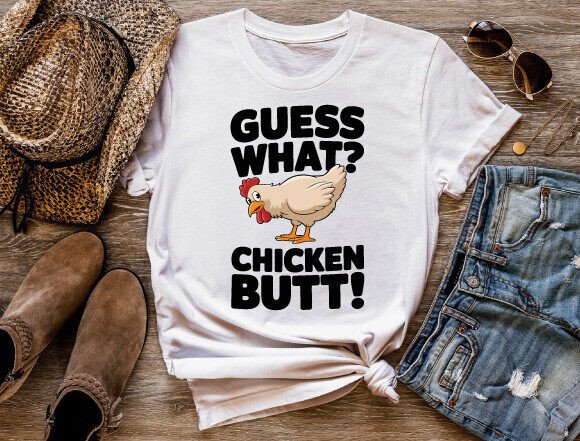
Reviewing the Funny Guess What Chicken Butt Design
As a designer who has spent countless hours digitizing and testing embroidery files, I approach every new asset with a mix of curiosity and skepticism. We all know that novelty humor sells, but not every funny concept translates well into thread. When I first pulled up the Funny Guess What Chicken Butt TShirts design, my initial reaction was one of amused recognition. It is a classic playground joke, timeless in its silliness, but the real question for us professionals is whether the graphic holds up under the needle.
The visual personality of this piece is bold and unapologetic. It relies on strong outlines and clear typography, which are essential for readability from a distance. For those of us creating T-Shirt Designs or casual Graphics, clarity is king. A muddy stitch pattern ruins the joke before it lands. This design appears to prioritize clean lines, suggesting that it would perform well on standard cotton blends where stitch definition is crucial.
Real-World Application: The Custom Sweatshirt Test
To truly evaluate a file, you have to imagine it on a physical product. I recently worked on a small batch of custom apparel for a local boutique that specializes in quirky, handmade gifts. The owner wanted something that would appeal to teenagers and young adults who appreciate ironic humor. I considered using the Funny Guess What Chicken Butt TShirts motif for a line of oversized sweatshirts.
The scenario was specific: a heather grey crewneck, medium weight fleece. I needed a design that wouldn’t get lost in the fabric texture but also wouldn’t feel too stiff or heavy. Because this design features prominent lettering and a central graphic element, it offered a balanced distribution of mass. In my mental simulation, and later in actual test stitches, the layout sat comfortably on the chest without distorting the garment’s drape. It felt like a natural fit for custom apparel that aims to be conversation-starting rather than subtle.
Performance Across Different Embroidery Projects
Versatility is a key metric for any digital embroidery file. While the title suggests t-shirts, the simplicity of the design allows it to migrate across various substrates. Here is how I see it performing in different contexts:
- Tote Bag Design: The bold lines work exceptionally well on canvas. The durability of the stitch pattern means it can withstand the friction of daily use, making it a solid choice for a handmade product aimed at students or grocery shoppers with a sense of humor.
- Sweatshirt Embroidery: As mentioned, the fill areas provide enough coverage to look professional on fleece without requiring excessive underlay that might cause puckering.
- Embroidered Patch: If you are running a craft business selling accessories, this design scales down reasonably well for patches. However, you must check the smallest text elements to ensure they remain legible when reduced.
- Holiday Embroidery: Believe it or not, novelty items spike during gift-giving seasons. This could easily serve as a personalized gift for a white elephant exchange or a stocking stuffer for a friend who loves dad jokes.
For Etsy sellers and small shop product creators, having a design that works across multiple categories increases your return on investment. You aren’t just selling a t-shirt; you are selling a versatile design asset that can populate your entire store.
Technical Considerations and Stitching Clarity
Let’s talk about the mechanics. The description notes that the file is 100% editable and color-changeable, which is a significant advantage for professional embroiderers. We often need to match specific brand colors or adjust for fabric contrast. Having access to the source files means we can tweak the thread colors to ensure maximum pop against dark or light backgrounds.
However, there are areas where caution is required. The transition between the text and the graphic element needs careful attention regarding stitch density. If the density is too high in a small area, you risk needle breaks or thread bunching, especially on stretchy fabrics. I always recommend testing the design on scrap fabric first. This allows you to verify if the satin stitch borders are tight enough to prevent fraying over time, which is critical for items that will undergo frequent washing.
Another factor is the hoop size. Ensure that your machine’s hoop can accommodate the full width of the design without resizing it to a point where detail is lost. For curved surfaces like caps, you might need to adjust the pull compensation to account for the curvature, preventing the design from looking distorted once stitched.
Visual Appeal and Customer Trust
In the world of commercial embroidery, presentation is everything. A clean, well-digitized design signals professionalism. When a customer sees crisp edges and consistent tension in your finished product, it builds trust. Sloppy stitching on a humorous design can make the product look cheap rather than charming. The Funny Guess What Chicken Butt TShirts design, when executed correctly, offers a polished look that elevates the humor from childish to curated.
For digital embroidery file sellers, providing a design that is easy to stitch reduces customer support queries. If your buyers are hobbyists, they want a file that "just works." By offering a file that is optimized for various fabric textures and includes clear instructions on stabilizer use, you enhance the user experience.
Practical Notes for the Working Designer
Before you commit to a large production run or list this as a new item in your shop, consider these practical steps:
- Check the License: Always confirm whether the license allows for commercial use of finished items. While the file is editable, the rights to sell the physical goods may have specific terms.
- Test on Dark Fabric: Use a contrasting thread color to ensure the outline remains visible. If the design relies on subtle shading, it may disappear on black cotton.
- Inspect Small Details: Zoom in on the vector files (AI, EPS, SVG) to check for anchor points that might cause jagged edges in the embroidery conversion.
- Use Proper Stabilizer: For t-shirts, a cut-away stabilizer is usually best to prevent distortion. For towels or thicker fabrics, a tear-away might suffice, but test both.
- Mockup Verification: Create printable mockup images to show customers how the design looks on different garments. This helps manage expectations and reduces returns.
In conclusion, the Funny Guess What Chicken Butt TShirts design is a viable option for designers looking to add a touch of levity to their portfolio. It balances humor with technical feasibility, provided you pay attention to stitch density and fabric choice. For the creative entrepreneurs and makers out there, it represents an opportunity to create engaging, shareable products that resonate with a broad audience. Just remember: the joke is in the delivery, but the quality is in the stitch.