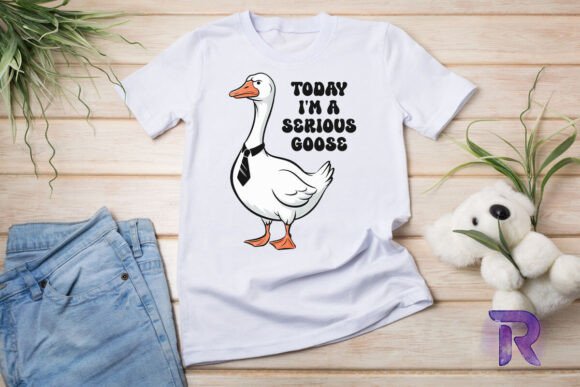
Reviewing Today I’m a Serious Goose PNG for Stitchers
As a designer who spends half my life digitizing files and the other half testing them on actual fabric, I have learned to look past the glossy mockups. When I first encountered Today I m a Serious Goose Funny PNG, my initial reaction was not just about the humor, but about the structural integrity of the graphic. In the world of embroidery, a cute concept can quickly turn into a stitching nightmare if the lines are too thin or the details are too dense. However, this particular design caught my eye because it balances personality with simplicity, making it a strong candidate for various embroidery projects.
First Impressions and Visual Personality
The mood of this graphic is immediately disarming. It captures that specific internet-era humor where animals are anthropomorphized with deadpan expressions. For an embroidery file to work well, it needs clear silhouettes, and this goose delivers. The layout suggests a bold, central figure that does not rely on microscopic details to convey its message. This is crucial for machine embroidery, where tiny elements can get lost in the pile of the thread or cause breaks during high-speed stitching.
From a visual standpoint, the design feels versatile. It is not overly complex, which means it avoids the trap of excessive stitch density that can make fabric pucker or feel stiff. Whether you are looking at it as a T-Shirt Designs asset or a standalone graphic for home decor, the clean lines suggest it will translate well into both satin stitch borders and fill stitch bodies. The "serious" expression relies on minimal facial features, which is a blessing for embroiderers. It means fewer tiny jumps and less risk of thread nesting in the eyes or beak area.
Real-World Application: The Tote Bag Test
To truly evaluate Today I m a Serious Goose Funny PNG, I imagined applying it to a real-world product. Let’s consider a custom canvas tote bag. This is a staple item for any Etsy seller or craft business. Canvas has a distinct weave and texture, so the design needs enough weight to stand out without sinking into the fabric.
In this scenario, the goose’s bold outline would likely perform excellently. Using a medium-weight stabilizer would ensure the canvas remains taut, allowing the thread colors to pop. I would recommend using a contrasting thread for the outline—perhaps a deep charcoal or navy against a natural beige canvas—to emphasize the "serious" nature of the bird. The result would be a handmade product that feels professional and durable, rather than flimsy. Customers appreciate when embroidered items hold their shape after washing, and a design with moderate density like this one is less likely to distort the fabric over time.
Apparel and Wearable Goods
Moving beyond bags, let’s talk about custom apparel. This design is perfectly suited for sweatshirt embroidery. The thick, cozy fabric of a crewneck sweatshirt provides an ideal backdrop for humorous graphics. Here, the size of the hoop becomes important. You would want to ensure your hoop size is large enough to capture the full width of the goose without cropping the wings or the text. If the PNG includes text, pay close attention to the font thickness. Thin serif fonts often fail in embroidery; if this design uses blocky, sans-serif lettering, it will stitch cleanly.
For baby embroidery projects, such as onesies or bibs, caution is required. While the theme is funny, babies have sensitive skin. Ensure that the back of the embroidery is finished neatly, perhaps with a soft cut-away stabilizer, to prevent irritation. Also, consider scaling the design down. A massive goose might overwhelm a small infant garment, but a pocket-sized version could be adorable and subtle.
Navigating Fabric Challenges
Not every fabric is forgiving. When working with Today I m a Serious Goose Funny PNG, you must consider the material. On stretchy fabrics like jersey knits, a dense fill stitch can cause the garment to warp. In these cases, consider converting parts of the design into an applique design. By using fabric pieces for the body of the goose and only stitching the outlines and facial features, you reduce bulk and maintain the stretch of the garment. This technique is also great for creating unique design assets for boutique branding.
Dark fabrics present another challenge. If you are stitching on black or navy, you cannot rely on the fabric color to define the shape. You must use light-colored threads for the entire design or add a white underlay. Always test your digital embroidery file on a scrap piece of the same fabric first. Check the tension and ensure the running stitch connections are not visible on the front. This step saves you from ruining a final finished product meant for a client.
Commercial Viability and Brand Consistency
For small shop owners and commercial embroidery professionals, consistency is key. This design offers a consistent aesthetic that can be part of a larger collection. Imagine pairing this goose with other "serious" animals for a themed line of holiday embroidery gifts or everyday wear. It builds brand recognition. When customers see that distinctive, bold style, they associate it with quality.
However, before listing this as a small shop product, you must verify the licensing. Since the source describes it as a PNG suitable for printables and transfers, you need to confirm if it includes vector files or specific embroidery formats like PES or DST. If it is purely a raster image, you may need to digitize it yourself or hire a digitizer. Never assume a PNG is ready for the machine without proper conversion. Check whether the license allows for commercial use of the finished items. Some creators allow you to sell physical goods but prohibit reselling the digital file itself.
Practical Designer Notes
- Test on Scrap Fabric: Always run a test stitch-out on the same type of fabric you plan to use for the final item. This reveals issues with tension and density.
- Check Thread Contrast: Ensure your thread colors contrast sufficiently with the background fabric. Low contrast can make the design look muddy from a distance.
- Review Stitch Density: If you are digitizing this from the PNG, avoid over-packing stitches. Let the thread breathe to keep the fabric soft.
- Confirm Hoop Size: Measure the design dimensions against your machine’s maximum hoop capacity. Do not attempt to hoop beyond the safe zone.
- Inspect Small Details: Zoom in on the eyes and beak. If they are too small, consider simplifying them or using a single satin stitch column instead of complex fills.
- Mockup in Black and White: Convert the image to grayscale to check value contrast. If the design disappears in black and white, it may lack definition in thread.
- Use Proper Stabilizer: Match the stabilizer to the fabric. Cut-away for knits, tear-away for wovens, and wash-away for delicate or sheer materials.
In conclusion, Today I m a Serious Goose Funny PNG is a promising asset for those willing to put in the preparatory work. It offers charm, clarity, and commercial potential, provided you respect the technical limitations of embroidery. By treating it with the care it deserves—testing, adjusting, and finishing properly—you can create personalized gifts and products that stand out in a crowded market. Whether for a tote bag design or a quirky embroidered patch, this goose has the potential to be a serious contender in your portfolio.